Pull up four different sites this week and search for the same thing: Sewickley home prices. You will get four different answers, and not by a little. One shows an average home value a shade over half a million dollars. Another, tracking a specific pocket of the same zip code, shows an average north of $1.3 million. A third shows a list price that dropped ten percent in a single month. None of these numbers is wrong. They are measuring different things and calling them by the same name.
The reason isn't sloppy data. It's a property line, drawn nearly a century ago, that still decides which Sewickley you're actually looking at.
A Compact, Not a Zoning Board
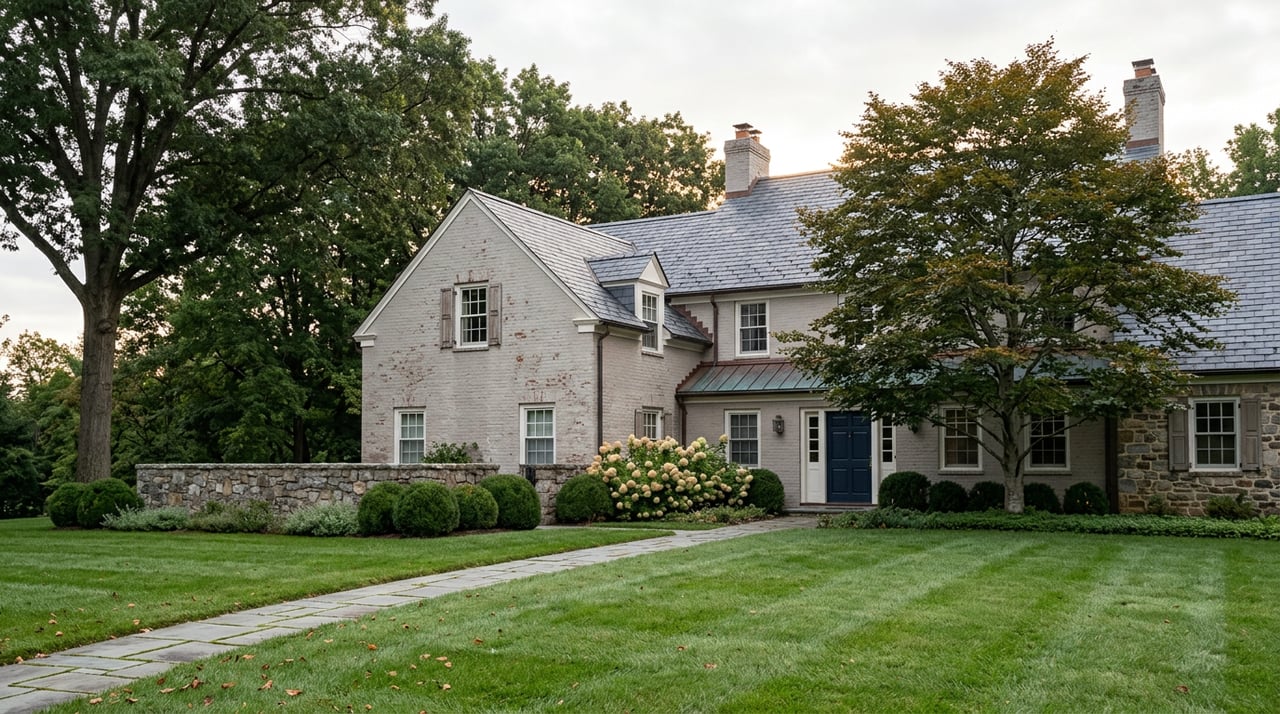
Most suburban lot-size rules trace back to a planning commission vote. Sewickley Heights is different. According to the Allegheny Land Trust's Sewickley Heights Vision Plan, the five-acre residential lot minimum that still governs the borough came from a Land Compact and Declaration of Restrictions, a document landowners themselves signed and Borough Council adopted, not a zoning ordinance imposed from outside. The character had already been set decades earlier: the Allegheny Country Club relocated to the area in 1902, drawing wealthy Pittsburgh families who built estates on hundreds of acres, and the borough incorporated in 1935 to protect what those families had built.
Half a mile down the hill, Sewickley Borough grew up differently. It's a compact, walkable downtown with three protected Historic Districts, where any exterior change to a home requires a Certificate of Appropriateness from the Historic Review Commission before the borough will issue a building permit. Same name, same MLS system, two entirely different sets of rules about what you can build and where.
That single distinction, five acres versus a rowhouse-scaled lot, is the entire explanation for why the numbers you find online don't agree with each other.
Not All Five-Acre Lots Are Equal
Here's where it gets more interesting for anyone actually shopping in the Heights. The Vision Plan notes that some of the borough's five-acre parcels were assembled using sloped, largely unbuildable acreage to hit the minimum on paper, citing lots on Treetops and Winterberry Lanes as examples. The report goes further: it expects developers to keep using this technique precisely because a Sewickley Heights address carries enough prestige to make squeezing extra building sites out of steep terrain worth the effort.
In practice, that means two listings can both say "five acres" and describe very different properties. One might be five usable, level acres. Another might be two usable acres and three acres of hillside that will never hold a structure. If you're comparing lots by the number on the listing sheet alone, you're comparing the wrong thing. Ask what's buildable, not just what's deeded.
The payoff for the acreage, when it's real, is substantial. Sewickley Heights Borough Park covers roughly 600 acres of hiking and horse trails that residents can reach without leaving the borough, and the Fern Hollow Nature Center and Sewickley Heights History Center share a 33-acre site nearby. That's the trade a Heights buyer is making: privacy and land, purchased with a commute to sidewalks and shops that the borough offers by default.
The Ordinance Most Buyers Don't Expect at This Price Point
Here's a detail that catches people off guard. Sewickley Heights' own list of governing ordinances includes an Amended and Restated On-lot Sewage System Ordinance and a Private Road, Shared Drive and Driveway Ordinance. Translation: a meaningful share of homes in this multi-million-dollar enclave run on septic systems and sit along privately maintained roads, not municipal sewer and public streets.
That's not unusual for large, historic estate lots, but it's easy to overlook when you're comparing a $1.5 million property to a $1.5 million property in a subdivision with curb, gutter, and a sewer authority bill. A septic inspection and a private road maintenance agreement are two extra conversations that belong in due diligence on a Heights property, conversations that simply don't come up for most borough purchases, where public utilities and paved public streets are the norm.
Four Numbers, One Month
Put the actual figures side by side and the split stops being theoretical.
As of July 31, 2026, the average home value across the broader Sewickley borough area was $507,174, up 3.2 percent over the past year, with homes going pending in around 12 days. The Sewickley Heights submarket, tracked separately, showed an average home value of $1,391,349 as of June 2026, up 6.2 percent year over year. Those two numbers alone are nearly three times apart, and they're both accurately describing "Sewickley."
Then add the volatility that low transaction counts create. In August 2026, one tracker showed the median list price for Sewickley at $599,000, down 10 percent from the prior month. A ten percent monthly swing in a stable, established suburb isn't a trend. It's what happens when only a handful of homes close in any given month and one unusually priced sale pulls the average with it. Earlier data points bear this out: one report counted just 16 homes sold across the entire Sewickley market in a single measured month, another counted only 9. When your sample size is in the single digits, the median is a coin flip away from a very different number.
The steadier read is price per square foot, which moves less dramatically because it isn't as easily skewed by one large estate or one small condo closing in the same month. That figure has hovered in the low-to-mid $200s per square foot across the periods measured here, a modest and believable range compared to the wide swings in headline medians.
What This Means If You're Comparing Neighborhoods
If you're cross-shopping Sewickley against other North Hills or river towns, don't anchor on a single median from a single site. Ask three questions instead. Which sub-area is this number actually built from, the walkable borough or the acreage district? How many sales is it based on this month? And does the price per square foot tell a different, steadier story than the headline number does?
The honest version of "what does Sewickley cost" isn't one figure. It's a choice between two products wearing the same name: a historic, walkable borough home subject to design review if you ever touch the exterior, or a private, acreage estate that may come with its own septic field and a shared gravel road. Both are real Sewickley. Neither one is the whole picture on its own.
Frequently Asked Questions
Is Sewickley Heights part of Sewickley Borough? No. They're separate boroughs with separate governments and separate zoning. Sewickley Heights sits adjacent to Sewickley Borough and shares the broader Quaker Valley community identity, but its five-acre minimum lot rule and its own set of land ordinances are unique to the Heights.
Can a five-acre lot in Sewickley Heights be split into two smaller lots? Under the Land Compact and Declaration of Restrictions that established the minimum, subdividing below five acres isn't the default outcome, though any specific parcel's history and any later ordinance amendments should be verified with the borough directly before assuming what a lot can or can't become.
Do all homes in Sewickley Heights have septic systems? Not necessarily, but the borough's own ordinance list confirms on-lot sewage systems are common enough to warrant a dedicated ordinance. Any buyer touring an estate-sized lot there should ask directly rather than assume municipal sewer service.
If you're weighing a move into the Sewickley area, or trying to figure out which side of that acre line actually fits how you want to live, Emily Wilhelm can walk through the sub-area breakdown with you property by property. Let's Connect.